Pameran Alat Muzik Tradisional Masyarakat Malaysia
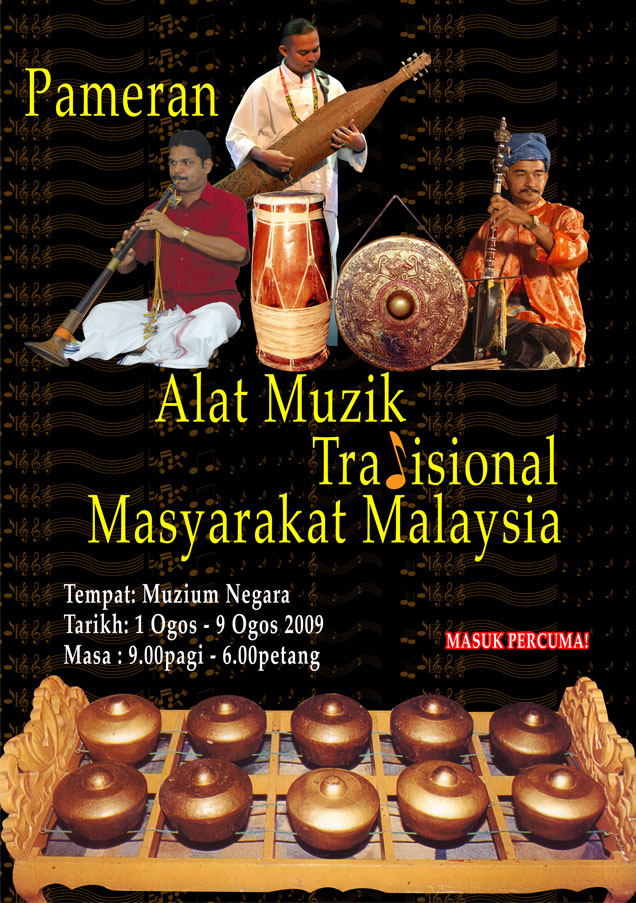
Lokasi pameran : Muzium Negara, Kuala Lumpur
Tarikh pameran : 1 Ogos hingga 9 Ogos 2009

Lokasi pameran : Muzium Negara, Kuala Lumpur
Tarikh pameran : 1 Ogos hingga 9 Ogos 2009
The International Seminar on the Champa Manuscripts held on 6 and 7 December 2004 by the Department of Museums, Malaysia provided researchers with the opportunity to learn about the condition of the Champa manuscripts currently preserved in libraries and in the Champa villages. It also allowed them to present their views relating to the privilege of having such resources in this 21st century, where the loss of the manuscripts was likened to the eradication of the collective memory of the Champa.
Monograph entitled Kajian Perbandingan Tapak Paleolitik Kampung Temelong dengan Kota Tampan dan Sumbangannya Terhadap Kebudayaan Zaman Pleistosen Akhir di Asia Tenggara by Mohd Mokhtar Saidin which was converted from his thesis.
This book by Zubaidah Shawal documents select Malay traditional costumes that reflect the character as well as the values and civility of Malay society. The book is bilingual: Malay and English.
Destar, which is also referred to as setangan kepala, tengkolok, tanjak, kain (ikat) kepala, represents a heritage headdress in Malaysia. Information on the destar is presented from various perspectives: historical, design, type, manner of its folding and its care in order to preserve its status in the art of Malay costume. The book is bilingual: Malay and English.
This book presents the chain of events leading to independence through newspaper cuttings, photographs and articles which demonstrate the nationalistic spirit of the leaders of the struggles and the elation of the people of Malaya as the country gained independence from the British. The book is available only in the Malay language.
The focus of the book is the formation of limestone hills and caves as well as the early cave-dwellers in the east coast states of Peninsular Malaysia, Kelantan, Terengganu and Pahang. The book is bilingual: Malay and English.
This publication presents information relating to the practice of foot binding as a subject that has been considered both interesting and intriguing from various aspects. The topic is discussed from the anthropological and historical perspectives. Photographs to demonstrate the uniqueness of this practice are presented for the viewing of readers. This book is written in two languages: Malay and English.
This features a collection of various artefacts from all over the world that is associated with the Malay world which includes the Malay archipelago and other areas which have geographical and cultural links with the Malay world such as South Africa and Indo-China (Champa). These artefacts currently form the department’s permanent collection. The book is bilingual: Malay and English.
This publication is among the efforts to preserve the status of one component of Malaysia’s heritage – the Jawi script. It traces the history of the Jawi script, with a selection of artefacts from the nation’s repository. The book is written both in Malay and in Jawi.